Capturing The Arch
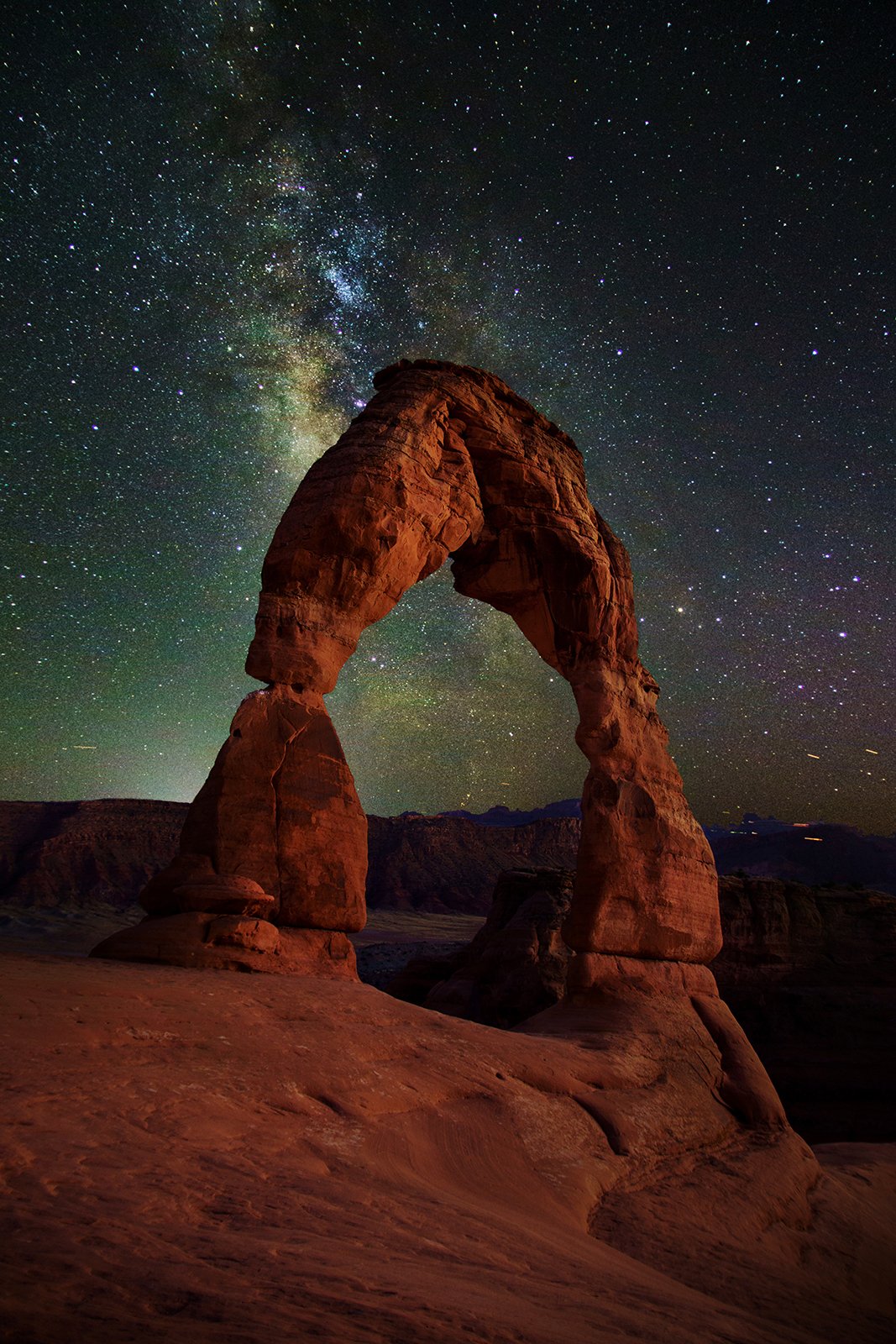
Standing beneath Delicate Arch at the end of the day, with the last light of sunset stretching across the desert, it was easy to understand why this place holds such a powerful presence. The sandstone glowed with warm tones as the sun dipped lower, highlighting the graceful curve that has made this formation one of the most recognizable natural landmarks in the American Southwest. During daylight the scene felt familiar, almost iconic, the kind of landscape that has been photographed countless times and yet still manages to draw people in. Visitors gathered along the slickrock to watch the sun fade behind the distant La Sal Mountains, cameras and phones raised as the arch caught the final moments of golden light. It was beautiful in a way that felt immediate and shared, but I had arrived with a different image in mind, one that would only reveal itself hours later when the crowds had gone and the sky transformed into something far more expansive.
Like many nights of photographing the stars, the work really began long before darkness arrived. The desert can feel deceptively simple during the day, all open sky and exposed stone, but creating a photograph that aligns the landscape with the night sky requires a certain amount of planning and patience. Before setting up my tripod, I spent time moving around the area, studying the shape of the arch and the lines of the surrounding rock, imagining how the sky might frame it once the stars began to appear. I knew the composition I wanted would depend entirely on timing and position, so I opened the PhotoPills app and began mapping out the path of the Milky Way.
Tools like PhotoPills make it possible to visualize the movement of the sky hours before it actually happens. Standing there in the fading light, I could trace the arc of the galaxy across the screen and watch how it would rise relative to the arch. The plan formed slowly as I adjusted the projection, stepping a few feet left or right, raising and lowering the tripod until the alignment felt right. According to the calculations, the Milky Way would lift from the horizon later in the evening, climbing into a position where its luminous band would stretch directly above the arch. On paper the plan was straightforward. Capture the landscape while there was still soft twilight illuminating the stone, then wait for the deep darkness that would allow the stars and the galactic core to appear in the sky.
Once I found the exact spot where everything lined up, I locked the tripod into place and marked it mentally as if it were anchored to the rock itself. For what I intended to create, the position of the camera could not change. The final photograph would be built from two separate moments in time, captured hours apart, but they would need to align perfectly to blend seamlessly together. Any shift, even a small one, would break the illusion. So once the legs were planted and the composition dialed in, that tripod became a fixed point for the rest of the evening.
As the sun slipped below the horizon, the desert entered that brief, beautiful transition photographers call blue hour. The sky deepened into a rich cobalt color while the last ambient light gently filled the landscape. During this window the harsh contrast of daylight fades away and textures begin to soften. The sandstone of the arch held just enough light to reveal its surface while the sky above it darkened into something quieter and more atmospheric. I began capturing a series of exposures, carefully balancing the light so the arch retained its natural color and detail without pushing into the heavy shadows that would soon take over the landscape.
This part of the process is subtle but important. The goal is not simply to photograph the arch before it becomes too dark, but to capture it in a way that feels natural within the context of the final image. Twilight provides a gentle illumination that mimics how our eyes remember the landscape at night, preserving the character of the stone without overwhelming the scene. Frame by frame, I worked through slight adjustments in exposure, making sure the highlights and shadows felt balanced. Eventually I had the image I needed, the arch resting quietly beneath the deepening sky, still carrying the last traces of daylight.
And then the waiting began.
Astrophotography often involves long stretches of stillness, moments where the camera sits quietly while the sky slowly moves through its cycles. The crowds that had gathered for sunset gradually disappeared, their voices fading as they made the hike back across the slickrock. The desert settled into a kind of calm that only really exists once darkness takes hold. Without the movement of people and the brightness of the sun, the landscape began to feel larger and more ancient, the curved silhouette of the arch standing against a sky that was steadily filling with stars.
At first they appeared one by one, faint points of light emerging from the deepening blue. Then more followed, and soon the sky felt dense with them. In places like Arches National Park, where light pollution is minimal and the air can be remarkably clear, the night sky reveals a staggering amount of detail. Constellations sharpen, the faint haze of distant star fields becomes visible, and the Milky Way slowly begins to separate itself from the darkness as a soft, luminous band stretching across the sky.
The hours passed quietly while the earth turned and the sky shifted overhead. Throughout that time the tripod remained exactly where it had been placed, a small but deliberate anchor in the vast openness of the desert. Every so often I checked the alignment through the camera, watching the horizon and tracking the movement of the stars as they crept closer to the position I had planned earlier in the evening.
Eventually the moment approached. Low on the horizon, the first hint of the Milky Way’s core began to rise, a faint glow that gradually intensified as it lifted higher into the sky. Even when you expect it, there is something quietly mesmerizing about watching the galaxy appear like this. What begins as a subtle smudge of light slowly reveals layers of detail: dense clusters of stars, dark lanes of cosmic dust, and the soft, luminous structure that defines the spiral arm of our home galaxy.
As it climbed higher, the arc of the Milky Way began to align with the arch below it, just as the earlier planning had predicted. The curve of the sandstone echoed the gentle sweep of the galaxy above, creating a composition that felt almost inevitable, as though the landscape and the sky had been quietly waiting to meet in that exact arrangement. I watched through the viewfinder as the stars sharpened and the band of the Milky Way stretched across the frame.
Timing matters here as well. The galaxy continues to move, slowly but steadily, and the balance between foreground and sky changes minute by minute. I waited for the moment when the curve of the Milky Way felt centered above the arch, when the relationship between the two shapes felt natural and complete. When everything aligned, I finally captured the sky that would complete the image.
The photograph you see here is what photographers often refer to as a blue hour blend. Rather than a single exposure, it is a composite created from two photographs taken hours apart from the exact same camera position. One frame captures the arch during twilight, when the landscape still held enough natural light to reveal its color and texture. The other frame captures the deep night sky, when the stars and the Milky Way had fully risen into place above it. Because the tripod never moved during the entire evening, those two moments can be seamlessly combined into a single image.
For me, images like this are a place where creativity and realism intersect. Much of my landscape photography focuses on capturing natural scenes exactly as they unfold in a single moment. But with night photography, especially in places with such dramatic skies, I sometimes enjoy leaning into techniques that allow for a more interpretive approach. A blue hour blend does not represent a literal instant in time, yet it still reflects the real experience of that night in the desert. The arch truly did glow in soft twilight earlier in the evening, and the Milky Way truly did rise above it hours later in the same position.
Bringing those two moments together simply tells the full story of the night in a single frame.
What stays with me most from evenings like this is not just the final photograph, but the quiet process of being present while the landscape shifts from day to night. Watching the desert empty after sunset, feeling the temperature drop as darkness settles across the rock, and seeing the first stars slowly appear overhead creates a sense of scale that is difficult to capture in words or images alone. The arch itself has stood in that same place for thousands of years, shaped by wind and erosion long before anyone thought to photograph it. Above it, the Milky Way stretches across the sky as it has for billions of years, a vast river of stars that reminds us how small our moment here really is.
On that particular night, those two elements felt briefly connected. Ancient stone below, an ancient galaxy above, both framed together through a bit of planning, patience, and a tripod that remained perfectly still through the passing hours.
This image is the result of that quiet stretch of time in the desert, when daylight faded, the stars appeared, and the universe slowly revealed itself above one of the most remarkable natural formations in the American Southwest. It is not a single moment, but rather the entire evening distilled into one photograph, a reminder that sometimes the most rewarding images come not from a single click of the shutter, but from the willingness to stay, to wait, and to watch the sky unfold.